4.05.2008

Postscript


The amount of inspiring art that we were exposed to was amazing.  The connections and friendships that developed strengthened the whole experience, and I'm really psyched about the contemporary art scene, especially in New York.  It's enough to make me want to move there!  It was also great to see the amount of support the museums, galleries and exhibitions were getting, and excellent that they were giving back to the community (like the Metropolitan Museum taking suggested donations, and the Chelsea galleries opening to the public).  I just wish there were more trees there.
The art scene extended to every level, and I loved all the art we saw on the way to the galleries also.

The Armory


The International fair of New Art at the Armory was exceptional.  Art galleries were representing from many countries, especially Germany for some reason.  The level of craftsmanship was top-notch, I suppose because the galleries are there to sell the art.  I only wish we could have stayed a while longer, and that I was a millionaire so that I could bring some of that home.  I guess i'll know where to go when I am though, right?  One piece that struck me was titled 'Flat Green Piss Painting' by Gavin turk (right).  After inquiring, I found out that the artist did indeed "arrange" his urine on a canvas that was painted with a metallic paint, then allowed to oxidize resulting in a flowing green painting.  I'm always interested in unusual techniques for creating design, and Turk definitely fit that bill.  This kind of venue had a really wide range of art, even if most were made to be sold.  That kind of parameter could inhibit the experimental process where some of the best results are realized, yet I felt that it wasn't very restricted.  It did not have the conceptual sculptures that reflect viewers like I had fallen in love with at Dia:Beacon, and the ideas executed weren't as far-reaching and experimental as the galleries around Chelsea District, but when it comes to the business of acquiring and selling art, this was as good as it gets.

P.S.1


We visited P.S.1 to see 'Whack!: Art and the Feminist Revolution.'  Included was art from many countries, from 1965 -'80.  Before going to this exhibit I would never have thought to fall in love with feminist art, but after seeing such a wide variety of expression from that movement I did indeed think about it, before disregarding the notion.  It's always fun to see expression of such force, with angst and frustration and anger spilling out of the art and into the viewer.  The feminist revolution was well represented, I think, by the art we saw there.  Materials ranging from oil paint to collage and mattresses, with messages ranging from subtle to extreme and in-your-face made it evident that a great variety of women were at this point united to the cause.  It's refreshingly stimulating to think that art can play a significant role in social change, and this exhibit could really help inspire future methods for change.  I didn't find the feminist concept very relevant for the current social climate, but it is an example of how free expression can prevail.  My favorite piece there wasn't about feminism as far as I could tell.

4.04.2008

Tom Burr


The Sculpture Center is an interesting building, renovated from an old trolley repair station.  It was here that they featured many of Tom Burr's newest sculptures.  His basic forms are the building blocks that transform into characteristic objects that for me take on a narrative quality.  For example, he used many long wooden slabs that were pieced together in a way that on a basic level suggested the human form, then added to it by placing personal items around and on them.  Sometimes they would face each other, suggesting an interaction and inviting a closer inspection of the items or surface treatment involved in giving these forms human qualities.  One was placed in a smaller white room by itself, and had a straight jacket draped over it under bright lamp light.  The atmosphere created by this placement of objects and personified forms was effective, and for me evoked a sense of unfinished narrative.  It was as if you were stepping into a scene that was permanently on pause, in limbo. 

Whitney Biennial


The Whitney Biennial featured a huge quantity of art this year, by many up-and-coming artists.  I found it very interesting, in that the majority of pieces I encountered were uninspiring and lacked a clear concept and/or the craftsmanship to convince me that they were actually complete.  That's not to say that there weren't effective pieces, but they were few and far between.  One piece I liked featured multiple glass rectangular shapes that were shipped via FedEx, as was evident by many which were still in their packaging.  The process of getting them to the Whitney was evidently a bumpy one, as they were cracked and split all over, allowing the viewer to imagine the various impacts on their trip.  The most interesting part for me was the project next door, away from the main gallery.  Set up there was a Neighborhood Public Radio station, featuring artists who endeavored to broadcast truly free radio.  Their idea stemmed from the changes that National Public Radio has undergone, which are now far from the ideals of the public, according to them.  Their mission was to broadcast anything and everything from the surrounding neighborhood, inviting people from off the street and setting up microphones at a station in the Whitney's bottom floor.  We had an opportunity to get on the air; each of us expressing our thoughts on the Whitney's Biennial in only a few choice words each.  This is a program that I hope to see more of.

MoMa


"Color Chart: Reinventing Color."  That was the name of the exhibit at the Museum of Modern Art which gave a retrospective look at the transformation to standardized manufactured colors.  Before that colors in traditional and non-traditional pieces were very much up to the individual to express their specific idea.  This exhibit featured many artists' experimental projects with color, some leaving their color decisions up to chance or arbitrary means.  The atmosphere was extremely stimulating but quickly waning, with florescent lights and vivid juxtapositions of every color imaginable jammed into every corner of the galleries.  Color still can have a very specific meaning for an individual, whether it's the paints they mix or the shirts they wear.  The art I saw that day made me more appreciative of those personal choices that we make, that are unique to every person's taste.  The idea of mass-producing color limits the individual, which is an interesting subject to take on in a piece of art, however I found myself uninterested by the impersonal quality of those there.  My personal ideals in color are that of personal expression, not in pleasing the majority.  

Subodh Gupta


In the back of a gallery we stumbled upon the works of Subodh Gupta, entitled "Still, Steal, Steel."  Three sculptures stood around the back of this gallery, eery constructions of large proportion heads made up of metal objects (steel, one could guess).  Except for the handcrafted look of the facial features, these heads wore the remains of hundreds of discarded nick-knacks, including pans, ladles, and cups to name a few.  They were military in uniform, the heads wearing a ski-mask, gas-mask, and helmet respectively.  Perhaps this was a comment on the rigidity of process and structure that current military practices have, or of the cold composure the ideal soldier has in battle.  Maybe the use of hundreds of very small objects to construct a large objects is an allegory to modern militaries.  The faces are american and unexpressive, combining with the material and unsaturated colors for a hard, cold feeling as one walks around them.  Gupta executed the facial features extremely well, and overall I was very impressed by his craftsmanship here.

Sol DeWitt


At first when I saw this piece (entitled "Scribble"), I was impressed by the fine detail in the forms depicted, in what I thought was a painting.  I was informed that it was all hand drawn by assistants of Sol DeWitt, in graphite.  Not only that, during the 4-week process of scribbling, DeWitt passed on, making this his last piece.  The formal elements are direct - gradations in value make up the illusion of form, that of round objects, abstractly composed one on top of another.  The extreme detail is reminiscent of Jackson Pollock, creating a huge variability of detail that unifies the whole piece.  Experiencing the piece walking by and with your nose an inch away from the surface are two very different experiences with this piece.

Joel Coen


Escaping the gallery scene, containers were set up by DIVA street-side, featuring digital art pieces by various artists. One that was particularly interesting to me was a container with two pieces by Joel Coen. Upon entering, one encountered a sculpture of a cross made up of dozens of small digital television screens that were all showing different television programs. The cross is an immediate connection to religion, and speaks about our culture's addiction to The Tube. The devotion to television and movies in the United States is extreme, and that piece was a straightforward message about that. Further inside, three projectors were set up, displaying a bizarre film. Each projector showed a different angle of the action, which centered around a shaved and naked man. This oafish fellow stumbled through what looked like a cave, where dozens of other shaved people lay bloated and immobilized on stretchers, shelves, or on the ground. Another section of this piece depicted the man sleeping or otherwise unconscious in a large crib, which slowly filled up with a strange murky water until he was floating, in the fetal position, in the dark liquid.
I believe these pieces were tied together in concept, that of American over-indulgence in entertainment and the service industry (which is now the highest-profiting industry in the country). The dark images of the stumbling or unconscious man possibly represented our plight as we allow the will of others to govern our lives for the sake of ease, forever numbing the otherwise creative and unique minds with the capacity to flourish that each individual possesses.

Brian Jungen


Brian Jungen is an artist we saw, who took consumer items and recontextualized them for his show.  This included recognizable football jerseys, which he cut into strips and rewove them into blanket-like forms that were reminiscent of native american patterning.  Also on display was his Jerrycan, a used gas canister that he drilled intricate hole patterns into.  The act of taking this item, which litter streets and are generally used in a very crude manner, and turning it into a piece that is displayed on a pedestal in a gallery stretches the mainstream ideas of what makes art.  This use of putting this mass-produced object speaks about the effects of globalization on the environment, and culture; for me criticizing how the individual is overlooked to produce efficient and disposable objects for a large population.  Making an object like this your own through artistic re-interpretation gives an object different meaning, and the relationship he's created with the jerrycan speaks to his own life living on a reserve and frequently reusing discarded mass-produced items for new purposes.

Marcel Zhama


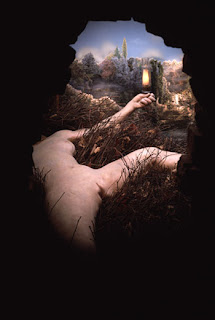
Marcel Zhama was featured in a gallery that we checked out in the Chelsea District.  One of his most interesting works was a sculptural piece referencing Marcel Duchamp's "Étant Donnés."  In the original, a large wooden door hid a nature scene with a naked figure, viewed through one of two peepholes in the door ( right).  It was thought that this piece (which was his last) was Duchamp's response to the deconstruction of images, and was considered less of a sculpture and more so a painting.  In this 'painting without a picture plane,' the objects are placed not on a two-dimensional plane as would be traditional, but placed in a three-dimensional context.  This context can only be viewed through a peephole, making the viewer's perspective the only definite condition of the piece.  Marcel Zhama recreated a similar context for his piece, with a large wooden door, a peephole, and behind it a scene of two naked figures lying on a hill, with a natural landscape that extends past a fox who gazes on.  The idea with the fox is that he was responsible for knocking out the two people.  The strongest part of this piece for me was the non-traditional role that the viewer plays.  One is made to feel like they are almost spying in on this scene, reminded of the subjectivity of their own perspective.  Also the unexpected nature of being confronted by a person's genitals in the piece can make the viewer uneasy (possibly).  This is a challenge to the ideas of what art, or more specifically a painting is.

Dia:Beacon


What a unique gallery Beacon is.  The large, expansive layout allowed for conceptual art of massive proportion, like Richard Serra's metal walls.  Rising maybe 20 feet, these slabs of dark metal curve into circular and spiral forms, leaving just enough room for viewers to walk into the dynamic space that he has created.  The walls fluctuate between leaning in over one's head and expanding into wide openings, making it impossible to walk through in any passive way.  In the center one finds another area, empty and devoid of anything but the space and the viewer.  These pieces force the spectator to readjust their normal routine of walking through rectangular spaces, like hallways or alleys, and consider their own size, shape, and movement as they relate to these cold dynamic sculptures.  
The concept of exposing the viewer to themselves through sculpture, is repeated in many of these highly conceptual pieces at the Dia:Beacon.  Although i've personally seen pictures of many of these types of works, they really only came alive for me in the physical experience of confronting them, and interacting in person.  Go to this gallery.